Late Precambrian – Cambrian Geology of Anglesey 21st – 23rd June 2013

admin@geoscience.wales
Tel / Fax : +44 (0)1492 550516

Date: Thursday, 18th April 2013
Venue: Royal Cambrian Academy headquarters in Crown Lane, Conwy @ 6:30pm. Refreshments @ 6:00pm.
Abstract:
There was a time when field geologists were content to call green granules in sedimentary rocks glauconite and have done with it, in fact the practice continues up to a point and two of the localities I shall discuss have been so described in the past, somewhat erroneously.
The seminal work of Odin and others in the 1980s showed that, in recent sediments, green granules of the chlorite family of clays (odinite-rich verdine) were only found in recent, shallow marine, low latitude sediments, while glauconitic granules occur on the outer shelf. I shall show that, in this instance the present is not necessarily a key to the past. In ancient sediments both chloritic clays and glauconite can be demonstrated to have formed in non-marine sediments, while glauconite in situ has been recorded in shallow (<50m?) marine sediments. The picture is further “muddied” by the fact that glauconite may be reworked into fluvial/estuarine sediments.
As glauconite is more clearly associated with very low rates of sediment deposition than are the chloritic clays, it may be that glauconitised faecal pellets are more frequently at an advanced stage of maturation, and hence induration, when buried, than are pellets replaced by chlorite. In terms of reservoir quality this means that glauconite is less likely to result in poor reservoir quality than is odinite (or chlorite as it becomes with diagenesis). The fact that odinite-rich verdine deposits are found nearshore and seaward of deltas and estuaries suggests higher rates of sedimentation, and hence less chance of the pellets becoming sufficiently mineralised to be firm enough to resist compaction. If, at some stage in the transformation, clay is dissolved, this may provide the solutes necessary for chlorite rim precipitation, but at present this remains speculative.
Speaker Biography:
Dr Jenny Huggett is the proprietor of Petroclays, a consultancy specialising in clay mineral, and general clastic sediment analysis and petrography.
Petroclays was formed in 1990, and now in addition to working for the petroleum industry, works part time as a researcher and supervisor at the Natural History Museum, and the University of Oxford, Earth Sciences Department. From 1982 until 1990 Jenny was employed as a sedimentologist by BP. She obtained both her BSc and PhD from Imperial College, London.
Date: Thursday, 21st March 2013
Venue: Cambrian Academy headquarters in Crown Lane, Conwy @ 6:30pm. Refreshments @ 6:00pm.
Abstract:
It is widely acknowledged that diagenetic processes play a fundamental role in determining the volume, shape, size and distribution of porosity on carbonate platforms. However, our ability to predict the shape, size and distribution of diagenetic products is limited. In part this reflects the paucity of integrated, multi-disciplinary, multi-scale outcrop studies that reconstruct the temporal and spatial controls on the processes that controlled diagenetic fluid flux, and hence porosity modification. This presentation will focus upon an ongoing research programme at University of Manchester into the diagenetic modification of carbonate platforms in extensional basins. The studies combine quantitative, multi-scale descriptions of sedimentological, diagenetic, structural and petrophysical features. These data are supplemented by geochemical analyses and interpreted in the context of the tectonostratigraphy and burial history of the basin. Key datasets are taken from the Lower Carboniferous of North Wales and Northern England, and Eocene of the Sinai rift. The diagenetic overprint of these areas will be compared, focusing in particular on dolomitisation, mineralisation and calcite cementation, and the potential to extract rules that better predict porosity distribution will be assessed.
Speaker Biography:
Dr Cathy Hollis is Senior Lecturer in Petrophysics and Petroleum Geocience at University of Manchester, where she leads a team of postgraduate and postdoctoral researchers working on industrially sponsored and research council funded projects in the UK, Europe, North Africa and the Middle East. Her research focuses primarily on the diagenetic modification of carbonate platforms during burial Cathy received her BSc from University of Birmingham in 1990 and PhD from University of Aberdeen in 1995. She then worked as a consultant carbonate sedimentologist for Badley Ashton and Associates Ltd., during which time she established their Middle East office in the UAE (1999-2001). In 2001, Cathy joined Shell International Exploration and Production in The Netherlands, where she worked for six years conducting both technical service support and research. Between 2005 and 2007, she led the Carbonate Research Team for Shell and was Subject Matter Expert in Carbonate Diagenesis.

Figure 1: Asbian and Brigantian (Dinantian) Limestone, Great Orme, Llandudno, which underwent multiple phases of post-depositional porosity modification, including karstification and meteoric diagenesis, dolomitisation, fault controlled carbonate cementation and mineralisation
Directions to the venue:
RCA, Crown Lane, Conwy, LL32 8AN
Lead by Marion Grundy Ridgewood, the field trip entitled “A field excursion to show the changing environments of deposition in the context of falling sea-level and structural deformation caused by contemporary movement of the Aber Dinlle and Great Orme faults”
was described in her own words as consisting of:
“A run through the sequence, looking at the dolomitisation of the Llanarman Ls and the duplicated sequence of the Leete Ls (it has a secret hidden crinoid assemblage!) – both by Happy Valley, the sandstone channel in the upper sequence of the Loggerheads Ls beside Mynedd Isaf, the awesome fossil assemblages in the Cefn Mawr Fm at Bishop’s Quarry and the syn-sedimentary deformation of the chert-rich Red Wharf Ls at the top. Mainly the aim is to show the changing environments of deposition in the context of falling sea-level and structural deformation caused by contemporary movement of the Aber Dinlle and Gt Orme faults.”
The geology of the Great Orme 11th July 2013
Date: Thursday, 28th February 2013
Venue: YHA Conwy, Larkhill, Sychnant Pass Road, Conwy, LL32 8AJ @ 6:30pm. Bar open from 6:00pm.

Abstract: Reservoir characterization of Middle Eastern carbonate reservoirs is challenging, primarily due to the occurrence within carbonates of a wide range of heterogeneities occurring at a wide range of scales. Sources of heterogeneity in carbonate reservoirs can be divided into 3 main categories: i) Primary (depositional) heterogeneity; ii) Secondary (diagenetic) heterogeneity; iii) Structural (fracture) heterogeneity. In the case study presented here we focus on the prolific Mid Cretaceous Sarvak and Mishrif formations of the Mesopotamian Foreland Basin and Zagros Fold Belt of Iran and Iraq. In the subsurface these reservoirs are buried to depths of 1000-5000m, and datasets available for prospect development or reservoir characterisation typically comprise 2D and sparse 3D seismic and well/core data of variable vintage and quality. However, rapid Tertiary uplift associated with river incision has resulted in spectacular pseudo-3D outcrops of the same reservoir units in the Zagros Mountains. The outcrops are often located between 10-40km from the subsurface exploration and production targets, and expose an almost identical stratigraphic and depositional succession. In addition, the outcrop diagenetic and structural template is often comparable to the subsurface. An integrated approach utilizing traditional geological field work with remote sensing and VGR (Virtual Geological Reality) techniques has been employed.
The main drivers for the VGR work has been to:- 1) Develop efficient exploration workflows in onshore frontier basins; 2) Allow rapid quantification of large outcrop geological datasets; 3) Access and utilize the inaccessible (many of the outcrop sections are km high vertical cliffs); 4) Time – Allow the field geologist to focus on observation and interpretation as opposed to traditional repetitive data collection (e.g. systematic line sampling of fracture systems); 5) To allow better bridging of the outcrop to subsurface gap.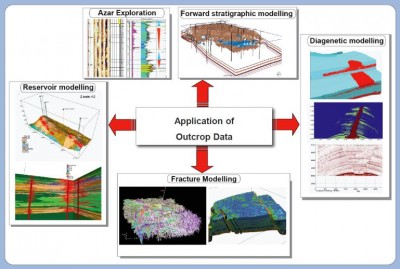
The resulting dataset and predictive framework has formed the cornerstone for all further work in the reservoir interval of interest, including Exploration (farm ins, block bidding rounds), Field Development (reservoir modelling template), Forward Stratigraphic Modelling (e.g. Dionisos), Fracture modelling (e.g. FRED, Fracperm), Diagenetic modelling (fracture controlled dolomites), Seismic Modelling and Basin Modelling.
Speaker Biography:
Ian Sharp is a senior specialist at Statoil working a range of basins and a Professor at Bergen University. He gained his BSc at the University of Hull (1988) and PhD at the University of Edinburgh (1994). Ian has worked in industry for the last 15 years (Norsk Hydro1998-2007, Statoil 2007-2013), primarily in the field of applied industrial research and technology development/implementation. He has worked on exploration and production projects globally, but with a focus on carbonate reservoir systems of the Middle East and the South Atlantic and clastic reservoirs of NW Europe. Prior to joining Norsk Hydro Ian worked as an industry sponsored post doctoral research associate at the Universities of Manchester and Edinburgh (1994-1998), and as a mapping geologist with the British Geological Survey (1988-1989). Ian has published over 30 scientific articles and presented numerous papers at international conferences. He is an active member of AAPG, GSL, SEPM, PESGB, NPF and is an IUGS reviewer for UNESCO’s program for the conservation of globally outstanding geological heritage.
Directions to the venue:

Date: Thursday, 15thNovember 2012
Venue: Cambrian Academy headquarters in Crown Lane, Conwy @ 6:30pm. Refreshments @ 6:00pm.
Abstract: Whatever the UK’s nuclear energy decisions, there is the very pressing problem of the UK’s legacy radioactive wastes that have to be dealt with. We have been producing high level radioactive wastes since the late 1940’s from weapons and nuclear power generation and this has left us with a heady mixture of complex ‘hot’ waste.
This includes the left overs from plutonium production and spent and re processed fuel rods. Much of it is situated at Sellafield in Cumbria and some of the earlier waste is in poorly contained open ponds.
In 2008, the UK decided to build an underground repository for this waste – but where? The nature of this legacy and the problem of where to stick it is a complex and very current saga.
Speaker Biography:
Professor Richard Pattrick, Executive Director, Professor of Earth Science and Senior Research Fellow, NNL, The University of Manchester
Professor Richard Pattrick’s research is in the fields of metallogenesis, pure and applied mineralogy and geochemistry; this work ranges from experimental investigations to field studies. The mineralogical investigations have focused on chalcogenides (esp. sulfides) and magnetic oxides, using experimental synthesis combined with spectroscopic analysis, including XAS techniques. The tetrahedrite group minerals have been a specific interest and more recently have focused on bio-nano mineralization produced by metal reducing bacteria. Metallogeneis has been focused on the base- and precious-metal mineralisation of the British Isles and worldwide, especially the mineralogical and genetic studies of mineral deposits, including the determination of their mineral chemistry, fluid chemistry, stable isotopic signatures and metallogenesis. Work using noble gases in fluid inclusions in the study of the formation of ancient mineral deposits is providing a novel insight into hydrothermal mineralisation.
| Date | Speaker name | Company of speaker | Title of talk |
| 27/02/2008 | Bill Hooley & Ian Cuthbertson | Anglesey Mining | Parrys Mountain Past & Present |
| 18/03/2008 | Eryl Vaughan | Windpower Wales Ltd. | Onshore windpower development in North Wales |
| 15/04/2008 | Andrew Barnwell | Barnwell Parker GeoScience | An Expedition on Mt McKinley in Pictures |
| 20/05/2008 | Rob Seago | Constant structural geologist | Integrating Structural Geology with Slope Stability issues in Open Pit Mine Sites |
| 17/06/2008 | John J. Walsh | University College Dublin | The Structure, Content and Growth of Fault Zones Within Sedimentary Sequences |
| 15/07/2008 | Bill Fitches | Constant structural geologist | Rhoscolyn Anticline Field trip |
| 14/10/2008 | Mike Bunter | B and R Co, Petroleum Consultants | Recent Developments in Petroleum Licensing in Iraq |
| 21/04/2009 | Dave Wallis | Head of Offshore Projects, RWE NPower Renewables | Building Offshore Wind Farms – A Pathway to Large Scale Renewable Power Generation |
| 16/06/2009 | Ian Phillips | Director – CO2 Infrastructure, CO2 Deep Store | Climate Change – What is the Oil Industry Supposed to Do? |
| 20/08/2009 | Ian Cuthbertson | Anglesey Mining | Parys Mountain Field trip |
| 30/09/2009 | John Collinson | John Collinson Consulting | Carboniferous Gas Reservoirs of the Southern North Sea: Sand body Geometry and Connectivity |
| 20/10/2009 | Joe Cartwright | Cardiff University | Hydrocarbon Migration and Sealing – Insights from 3D Seismic Data |
| 17/11/2009 | Jonathan Craig | Head Geology Global Exploration, ENI, Milan | Global Climate, the Dawn of Life and the World’s Oldest Petroleum Systems |
| 23/02/2010 | Dr Richard Bevins | Keeper of Geology, Museum of Wales, Cardiff | Geological Role of the National Museum in Wales, with examples of projects in North and South Wales’ |
| 13/03/2010 | Dr Jacqui Malpas | Geodiversity officer, Clwydian Range of outstanding Natural Beauty | Field trip to Coal Measures Forest Site at Brymbo (near Wrexham) & Clwydian Hills geology |
| 23/03/2010 | Eric Goulden | Celtest | Evening visit to the laboratories |
| 20/04/2010 | Dr Dave Schofield | British Geological Survey, Cardiff office | The Geology and Landscape Wales Project and current multidisciplinary geological studies in North Wales by BGS |
| 05/05/2010 | Dr Jeremy Davies | BGS, recently retired | The Welsh Basin – a Window on Deep Time Climate Change |
| 22/06/2010 | Dr Bill Hirst | Shell Research, Rijswijk | Airborne Surface Gas Flux Mapping for Hydrocarbon Exploration |
| 28/10/2010 | Keith Richards | KrA Stratigraphic Limited | Stratigraphy of the Caspian Sea |
| 29/11/2010 | Barrie Wells | CVS | Multi-Point Geostatistics: a Bluffer’s Guide |
| 20/01/2011 | Mads Huuse | Manchester University | The glacial history of the North Sea Basin: Implications for hydrocarbon and groundwater systems |
| 21/02/2011 | Paul Markwick | GETECH | The Value of Palaeoclimatology in Exploration |
| 21/03/2011 | Andy Barnwell | Barnwell Parker GeoScience | A Palinspastic Plate Reconstruction for the Southern North Atlantic, with Implications for the Development of the Basins Around the Grand Banks of Newfoundland |
| 18/04/2011 | Dave Schofield | British Geological Society | Recent mapping of Northern Madagascar by the British Geological Survey |
| 16/05/2011 | Steve Keyworth | Environment Systems | Environmental Applications of Remote Sensing |
| 20/06/2011 | Andrew Nunn | Dart Energy | Coalbed methane |
| 19/09/2011 | Mike Battersby | Maelgwyn Minerals | Innovation, Intellectual Property and Patents in the Resources Industry |
| 17/10/2011 | Paul Terry | NWSE Cymru Ltd | Proposed Tidal Impoundment scheme off the North Wales Coast |
| 12/01/2012 | Jim Harris | Fugro Robertson | The Plate Tectonic, Palaeogeographic and Palaeoclimatic Context for the Development of the North Atlantic Conjugate Margin Basins: Exploration Concepts and Petroleum Play Fairway Mapping |
| 15/03/2012 | Casey Hubert | Newcastle University | Distributions of microbes in petroleum reservoirs and at the seabed C Hubert & A Judd |
| 19/04/2012 | Richard Miller | Independent consultant on future oil supply | Future Oil Supply and why it matters R Miller presentation |
| 17/05/2012 | Kevin Taylor | Manchester University | Mudstones as shale gas reservoirs: multi-scale observations for improved characterisation |
| 21/06/2012 | Simon Price | BGS Nottingham | Arabian Adventures: Geological mapping in the United Arab Emirates |
| 04/10/2012 | Menno Dinkelman | ION-GX Technology | Interpretation of tectonics of passive margin of NE Greenland from new seismic reflection data and geological – geophysical constraints GWL – Cluster meeting – 4th October 2012 |
| 15/11/2012 | Richard Pattrick | Manchester University | Britain’s nuclear waste and where to stick it |
| 28/02/2013 | Ian Sharpe | Statoil | Exploration Field Geology in the Middle East http://pesgb.org.uk/events/event-112/ |
| 21/03/2013 | Cathy Hollis | University of Manchester | Diagenetic modification of carbonate platforms from extensional basins: a step towards predictive models? |
| 18/04/2013 | Jenny Huggett | Petroclays | Green Clays:Uses and Pitfalls |
| 11/07/2013 | Marion Grundy Ridewood | Liverpool University | Field Trip of the Great Orme |
| 19/09/2013 | Richard Dixon | Manchester University | Integrated petroleum systems & play fairway analysis in a complex Palaeozoic basin: Ghadames – Illizi Basin, North Africa |
| 17/10/2013 | Paul Pearson | Cardiff University | The Cretaceous and Cenozoic stratigraphy and palaeoclimate of southern coastal Tanzania: results from a decade of fieldwork and scientific drilling |
| 21/11/2013 | Andrew Hopkins | Independent | Seismic Interpretation – Ten Ways to be wrong |
| 12/12/2013 | Martin Evans | Cornell University | A Tale of Two Shales:Implications for the Global Shale Revolution |
| 16/1/2014 | David Bevans | Dolgarrog Power Station | Field Trip Tour of Power Station |
| 20/2/2014 | David Hodgetts | Manchester University | Digital Outcrop Models of Hydrocarbon Reservoir Analogues: An example from Alderley Edge, Cheshire |
Date: Thursday, 4th October 2012
Venue: Royal Cambrian Academy in Crown Lane, Conwy @ 6:30. Refreshments @ 6:00.
Speaker Biography:
Dr Menno G. Dinkelman joined ION-GX Technology in 2005. He is Chief Geologist BasinSPAN Programs with primary focus on the interpretation of the Arctic, North Atlantic and SE Asia programs. Prior to joining ION-GXT Dr Dinkelman was principal geologist at Gaffney, Cline & Associates. Throughout the 1980’s he was a senior research scientist /geologist Conoco and ARCO, and exploration advisor for the Ministry of Oil and Mineral Resources in the Yemen Arabic Republic. From 1973 to 1980 he was on the faculty of the Department of Geology at Florida State University. He has intermittently worked as an independent consulting geologist in Europe and the US. Dr Dinkelman holds degrees in the Natural Sciences and Geology from the ETH in Zürich and a PhD in Geological Oceanography from Oregon State University. He is a member of HGS, GCAGS, SEPM and SEG.
Abstract:
Three phases of deep 2D seismic acquisition and PSDM processing over the past 4 years provide regional coverage of the NE Greenland Atlantic passive margin. It is a Tertiary volcanic-rich passive margin developed upon a Caledonian orogenic crust and its cover. A foundation of Late Paleozoic successor basins, Mesozoic extensional basins, and earliest Tertiary transpressional zones are characterized by complexity now inherited in the segmentation and geometry of the passive margin prism. The array of basins and their deep architecture suggests a west to east, chronological progression of pre-rift, sag and oceanic rift basins in the NE Greenland shelf and slope. This presentation reviews the geology of the NE Greenland margins, one of the few remaining, completely undrilled major petroleum basins, incorporating the knowledge from recent seismic imaging.
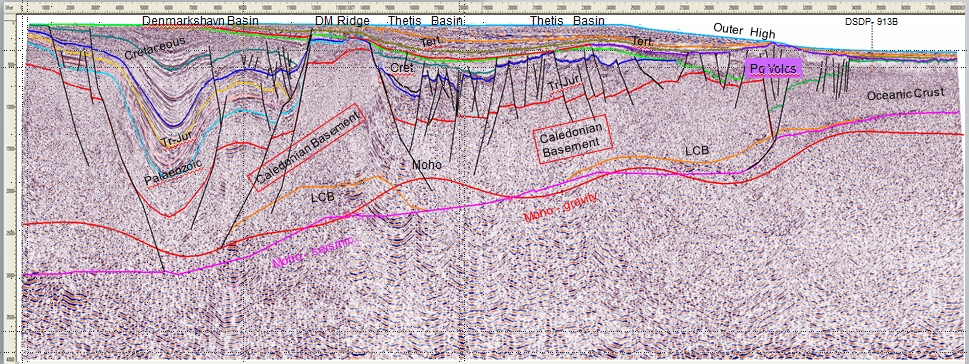
Fig. 1. PSDM Profile 1800, 380 km long, 40 km deep. Note both seismic and gravity interpretation of Moho. V.E. x 2.5